
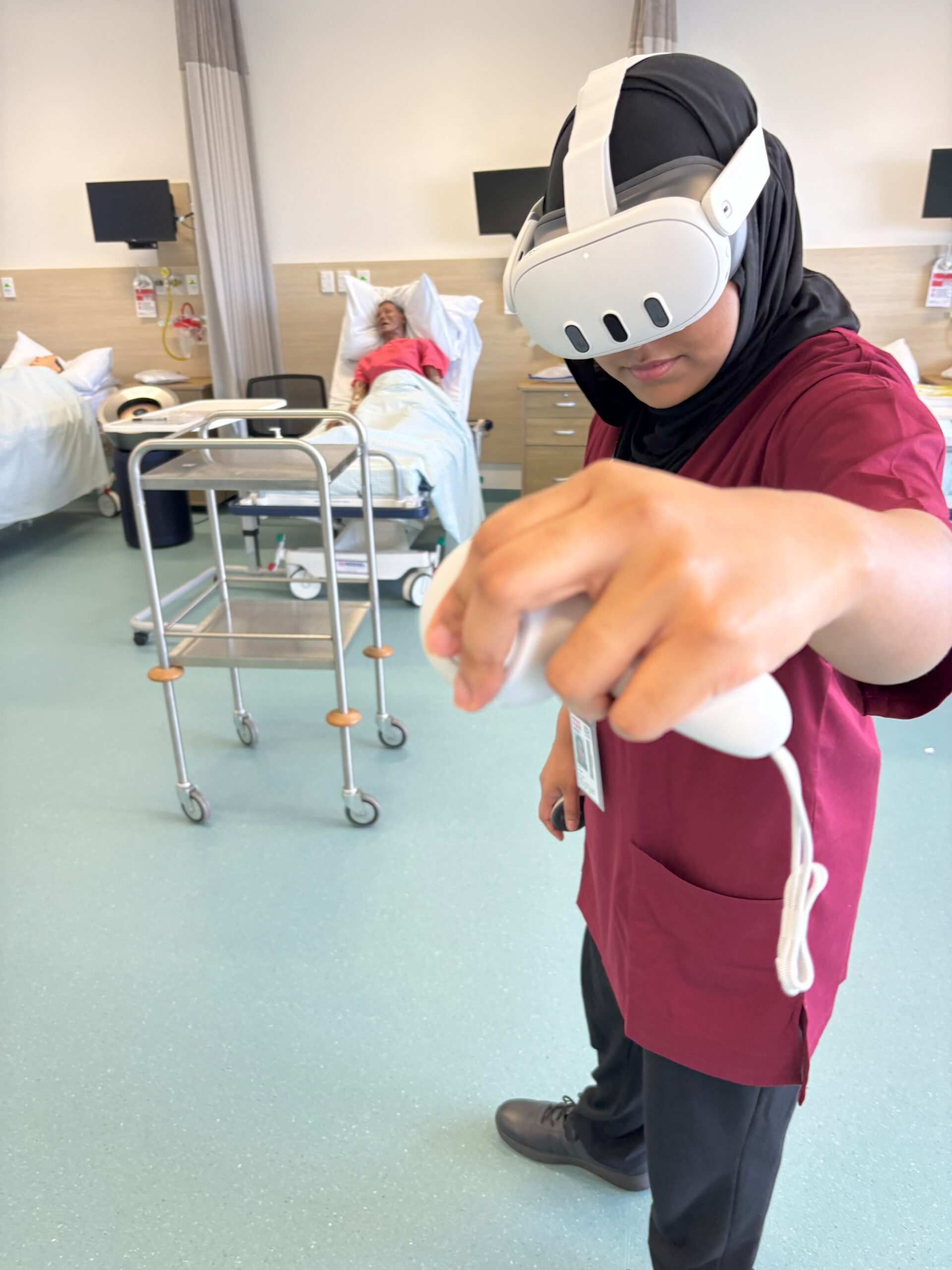
Virtual reality simulations boost nursing students’ communication skills, confidence, and readiness for real-world healthcare practice.
In a world where technology increasingly intersects with healthcare, nursing students are now getting a high-tech head start on their professional careers, through virtual reality (VR).
A recent pilot study has shown that immersive 360-degree VR simulations can significantly boost students’ communication skills, confidence, and readiness for the workplace.
Learning how to communicate effectively with patients is an essential skill for nurses to develop, yet one that can be challenging to master in traditional classroom settings. To address this, researchers integrated VR patient simulations into a nursing communications unit, giving students the chance to practice building therapeutic relationships in a safe, interactive environment.
Using the UbiSim™ platform, students donned Oculus Quest 3 headsets and entered a 360-degree immersive virtual clinical setting. Audio feedback from the virtual patient allowed dialogue to develop between the student nurse and the virtual patient that mimicked real-life conversations. Student observers watched the simulations on a projector screen. Half gave feedback based on advice given by artificial intelligence and the other half applied theoretical knowledge from what they had learned in the classroom. At the end of the session all students participated in a debrief based on Harvard’s Centre for Medical Simulation four-phases of debriefing model ‘debriefing with good judgment’.
Students commented on the immersive nature of the experience, with one noting, “Being ‘dropped’ into the scenario emulates the new environments and patients we would encounter on a placement.” Another student added, “The simulated patient can be programmed to respond to and/or challenge our developing communication skills. The VR simulation also allows us to develop our communication skills, in a safe environment; where mistakes or weaker skills do not have therapeutic and/or clinical implications.”
The results were striking. Students participating in the VR exercises demonstrated the capacity for enhanced employability skills, including critical thinking, adaptability, empathy, and communication competence. The experience also increased their awareness of real-world challenges in patient care, as well as the limitations of AI technology in clinical decision-making.
By merging classroom theory with immersive simulation, VR offers a promising tool to prepare nursing graduates for the complexities of professional practice. As healthcare evolves, such innovative training methods could become a standard part of nursing education, helping future nurses’ step confidently from the virtual classroom into real-world patient care.
References
Center for Medical Simulation. (2025). Healthcare simulation essentials: Design and debriefing | Center for Medical Simulation. https://harvardmedsim.org/course/healthcare-simulation-essentials-design-and-debriefing/
UbiSim. (2026). UBISIM | Virtual Reality training and simulation for nursing. https://www.ubisimvr.com/
Related Articles
Explore related articles and stay informed on the latest in Learning and Teaching at ECU.