

How educator-focused support helped power a smooth transition to ECU City.
The start of teaching at ECU City in Semester 1, 2026 is a significant milestone in the University’s strategic transformation. As a state-of-the-art campus located in the heart of Perth, ECU City positions the University as a global leader in contemporary higher education by bringing together innovative learning environments, quality teaching practices and emerging technologies, alongside a strong focus on student engagement, community and industry partnerships, and creativity.
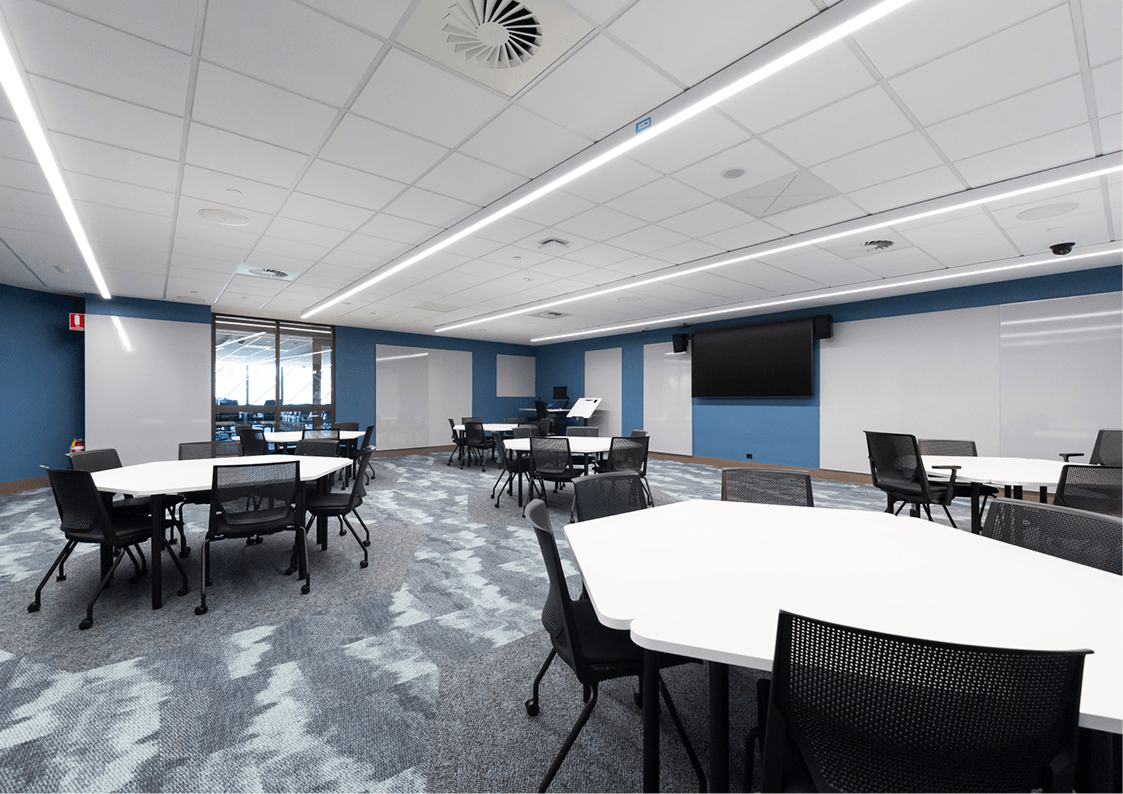
A key enabler of this transformation has been the Educational Experience (EdEx) project. As one of the major commissioning streams supporting ECU City’s ambitions, the EdEx project has focused on empowering educators to confidently teach in new environments and to harness the pedagogical potential of purpose-built spaces and technologies.
At the centre of this work is a clear proposition: meaningful transformation in teaching and learning occurs when pedagogy, space, and technology are intentionally integrated and supported through practical, educator-focused capability development.
Preparing Educators for the New Teaching Environments
In the lead-up to Semester 1 2026, the EdEx team delivered a structured, large-scale professional learning program within the ECU City teaching spaces. The aim was to familiarise staff with the new environments while building confidence in teaching practices aligned with contemporary, active learning approaches.
Every session was purposefully designed around the principles of personalised and authentic learning, ensuring educators experienced the same kinds of learning they would later create for their students. Rather than focusing solely on how to use the technology, the program emphasised how space, pedagogy and technology can be intentionally combined to create engaging, collaborative and inclusive learning experiences. Through hands-on practice, reflection and peer discussion, educators developed the confidence to experiment, the capability to make intentional teaching decisions, and the professional judgement to adapt these environments to the needs of their students.
Between January to March 2026:
- More than 80 workshops and drop-in sessions were delivered
- Approximately 850 staff including academic, professional and sessional staff participated
- Engagement included all ECU City-based Schools and key professional service areas
This approach was enacted through practical, in-space learning experiences that enabled staff to:
- Become familiar with teaching spaces and in-room technologies
- Practise core teaching tasks such as starting classes and sharing content
- Apply active, collaborative and student-centred teaching approaches
By situating learning directly within the teaching spaces, the program reduced uncertainty and supported a smoother transition into the first semester at the new campus. Critically, it shifted the focus from technology competence alone towards confidence in delivering quality learning experiences in new environments.
Hypercare: Supporting Teaching in Real Time
While pre-semester preparation was essential, the EdEx team recognised that confidence continues to develop in context. To support this transition, a Hypercare Teaching Space Support model was introduced for the first eight weeks of Semester 1.
This model provided visible and responsive support directly in teaching spaces in real time.

Key elements included:
- A team of approximately 25 trained staff and students
- In-room support for around 400 classes per week
- Real-time assistance to help educators start classes, use room technologies, and manage emerging issues
- Triage and escalation pathways connecting with ECU’s Digital Services and the City Campus Technology Project
Importantly, Hypercare was positioned as teaching and learning support rather than technical troubleshooting alone. This distinction reinforced its purpose. It enabled educators to focus on pedagogy while ensuring that technological or operational issues did not disrupt learning.
This model played a critical role in maintaining continuity in teaching and learning during a period of significant change. It also strengthened educators’ confidence to use the affordances of ECU City spaces intentionally.
Early Indicators of Impact
Unsolicited staff feedback provided early qualitative insight into the impact of the EdEx project’s initiatives on teaching practice and experience.
Increased Confidence and Readiness
A consistent theme was the shift from initial uncertainty to confidence:
“Before I felt scared, now I feel confident… I can focus on teaching and the students because I know how the room works.”
“My classes this week have been really smooth… I have felt much more confident in dealing with these issues.
“I feel a lot more confident in the classroom since we went through some tips and tricks to help me set up quickly.”
This reflects the effectiveness of combining pre-semester capability building with in-class support.
Evolving Teaching Practice and Student Engagement
Educators are beginning to adapt their approaches to better align with the design of the spaces:
“Mentimeter gets students engaged, talking and sharing… I don’t want to wait until the end of semester to find out what I can change now.”
“I can get students collaborating at their pods and sharing their work with the class in discussion.”
“I love teaching in these new spaces.”
These insights demonstrate early movement toward:
- More interactive and participatory learning
- Increased use of digital engagement tools
- Greater alignment between pedagogy and spatial design
Value of In-Room Support
The presence of Hypercare support was widely recognised as having high-value impact:
“This service has been critical… to help us create quality learning experiences for our students.”
“The support has been exceptional… especially as a new staff member.”
“I don’t feel isolated and unsupported while the tech becomes stable.”
For many educators, the initiative helped to reduced cognitive load and supported a focus on teaching rather than troubleshooting.
A Model for Sustainable Transformation
The successful launch of teaching at ECU City highlights the importance of a holistic and integrated approach to educational transformation at scale. Key lessons emerging from this work include:
- Embed capability development in authentic contexts so that learning is relevant and confidence grows quickly
- Prioritise pedagogy alongside technology to ensure effective use of space and tools
- Provide support at the point of delivery where it matters most
- Foster collaboration across academic, professional, and technical teams
By combining structured professional learning with responsive, in-class support, the EdEx project has established a model that enables a successful transition to the new campus and lays the foundation for ongoing innovation in teaching and learning.
What Comes Next
As teaching at ECU City continues to evolve, the EdEx team will build on these foundations and continue to work alongside educators to refine practice, deepen engagement, and further explore the potential of contemporary learning environments.
Plans are in place to implement a similar Hypercare support period in Semester 2, 2026 and Semester 1, 2027, ensuring continuity of support and strong outcomes for both staff and students as the University community continues to adapt and innovate teaching and learning at ECU City.
At its core, this work is about empowering educators and students alike by fostering curiosity, confidence, connection, and agency in a dynamic and future-focused educational landscape.
Related Articles
Explore related articles and stay informed on the latest in Learning and Teaching at ECU.