
A practical framework for developing AI literacy in higher education, helping educators integrate AI and build student confidence.
Learning for an AI World
A practical framework for teaching and learning with AI
Artificial intelligence (AI) is already part of how students learn. Whether we design for it or not, students are using AI tools to explore ideas, draft responses, and make sense of complex information. When left unguided, however, students risk using AI in ways that bypass learning or compromise the integrity of their work.
When students are explicitly taught how to use AI responsibly and given opportunity to practice, they develop more responsible AI habits (Sullivan et al., 2024; Susanto, 2026). Therefore, it is important to build opportunities for hands-on practice using AI in the curriculum.
AI-integrated learning is when AI is incorporated into the learning process in ways that help students reach a learning outcome. The goal does not change; students still need to know, understand or be able to do something they could not do before. When used well, AI can boost learning efficiency and comprehension (Araújo & Aguiar, 2023; Crompton & Burke, 2024), expand and deepen thinking (Baltà-Salvador et al., 2025; Rahman et al., 2025), provide personalised feedback (Bearman et al., 2024; Crompton & Burke, 2024), foster evaluative judgement (Bearman et al., 2024), build student confidence (Adamakis & Rachiotis, 2025; Crompton & Burke, 2024; Naznin et al., 2025; Rahman et al., 2025), make learning more inclusive (Crompton & Burke, 2024; Trust et al., 2023; Rahman et al., 2025, Jafry & Vorstermans, 2025) or more engaging (Adamakis & Rachiotis, 2025; Crompton & Burke, 2024; Hon, 2026). In all instances, AI should enrich the learning process, not replace it.
From this perspective, telling students that they can or cannot use AI in a task is insufficient; it does not role-model the variety of responsible ways students may leverage AI tools either during their studies or future workplaces. Such rules-based approaches are also difficult to enforce, arguably introducing more problems than they solve (Corbin, Dawson, & Liu, 2025; Dawson et al., 2024). Instead, curriculum needs to reform to create space for students to experience how AI can be used responsibly to meet a learning goal, in contexts where its value is explicit, discipline-appropriate and authentic (Sabzalieva & Valentini, 2023). To move forward, university educators need a clear and consistent view of what appropriate AI use in learning looks like.
What is the framework?
Edith Cowan University’s Centre for Learning and Teaching developed the Learning for an AI World framework to bring simplicity and clarity to how AI can be used to support learning.
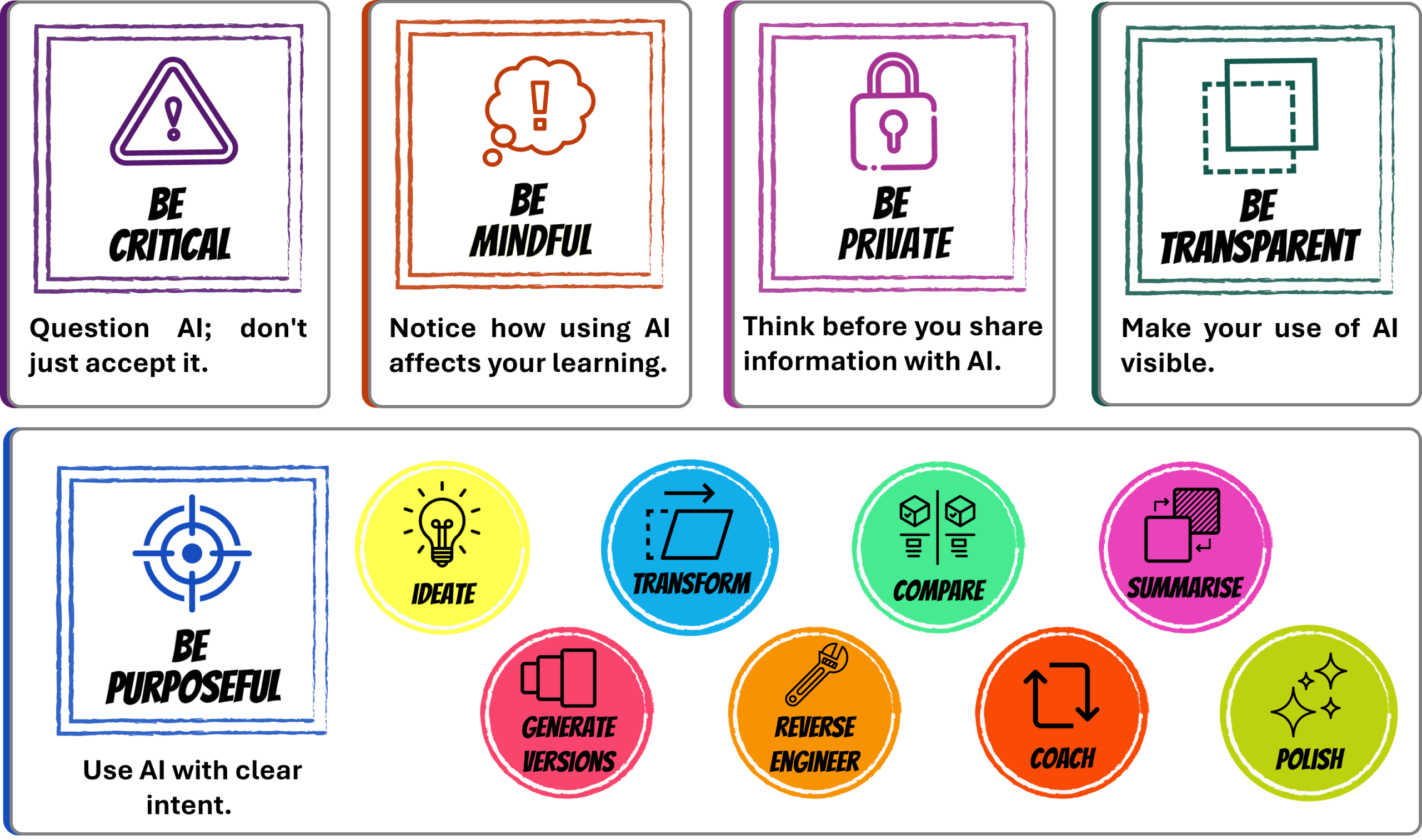
The framework organises AI-enabled learning into clear categories (Figure 1). These categories collectively showcase how AI can be used to support learning and include foundational risks that educators and students need to navigate when doing so. Importantly, these ‘risks’ are framed as useful guardrails that students draw on as they develop responsible approaches to AI (aka ‘AI literacy’).
A visual icon, known as an AI Stamp, represents each category and staff use these to signpost learning activities and assessment tasks where AI is purposefully integrated. These images are key to how the framework is operationalised and tracked in the curriculum.
Where students use AI as part of a learning task, they see an AI Stamp which signals the intended role of AI and explains how this use can support their learning or skill development. Notably, the framework does not aim to prescribe every possible way a student might use AI. Rather, the AI Stamps role-model responsible AI one learning objective at a time, and provide a shared language to instigate dialogue between educators and their students about responsible AI use in their discipline. Over time, this shared language helps students develop confidence to identify, explain and justify their own AI use in future learning and workplace contexts.
Image Above: The Learning for an AI World framework, with each category represented by a visual icon known as the AI Stamps.
What’s in it for educators?
For educators, the framework alleviates uncertainty around integrating AI into their teaching.
If the value of AI to learning is not clear, it is difficult for busy academic staff to justify integrating it into already crowded curricula. The AI Stamps help by making the pedagogical purpose of each AI use explicit, showing how it can support learning rather than distract from it.
It also simplifies the process. University educators can take a “just choose one” approach, starting with a single AI Stamp, focussing on a single way for students to use AI to enrich their process or work. This creates a manageable entry point, allowing educators to adopt AI uses that are relevant to their learning objectives and discipline. Of course, the versatility of AI tools means students will apply AI in a range of ways when completing a set task, but the educator will have predetermined what they believe is the most helpful application of AI to the learning task and are prepared to role model this to their students.
Over time the framework also creates a shared language between colleagues, making it easier to discuss, compare approaches, and build a collective understanding of effective practice.
I value the AI Stamps framework for bringing clarity and confidence to AI integration. It makes the pedagogical purpose explicit, helping educators adopt AI in purposeful, manageable ways through a simple “just choose one” approach. From a student perspective, this clarity translates into more meaningful learning experiences. Students better understand why and how AI is being used, allowing them to engage more thoughtfully and develop responsible, effective practices alongside their disciplinary learning. — Claire Lambert, Associate Dean of Teaching and Learning, School of Business and Law
What’s in it for students?
AI proficiency is quickly becoming workplace expectation for new graduates (Digital Education Council, 2025). Nonetheless, many students lack confidence in their AI knowledge and feel unprepared to enter an AI-integrated workplace (Digital Education Council, 2024). Developing confidence requires repeated, contextualised practice, where students engage critically with AI to deepen and extend their thinking while maintaining ownership of their work.
The AI Stamps make these learning moments explicit throughout the curriculum, helping students recognise when and how they are building this important capability. As a result, students graduate confident in their ability to use AI responsibly across a range of contexts and with a foundational language to articulate their AI use in their future workplaces.
Now I think of AI more like a learning partner rather than just a shortcut. Instead of asking for final answers straight away, I use it to: brainstorm ideas, break down difficult concepts, check my understanding, improve and refine my work. — Undergraduate Accounting student
Why AI-integrated learning matters to academic integrity
When students use AI repeatedly and authentically in learning tasks, they build their ability to judge when AI is useful, evaluate what it produces, and experience what it means to remain accountable for the final work. When coupled with learning and assessment designs that ask students to explain how and why they used AI, and to clarify their own contribution to AI-augmented work, AI-integrated learning can nurture academic integrity behaviours by rewarding transparency, honesty and accountability. Making these behaviours more visible also means educators are positioned to guide students’ decision-making, provide feedback on their AI use, and assess not only what students produce, but how responsibly they arrived there.
Are you an academic staff member at ECU?
Enrol in the AI Stamps Canvas Community for further guidance, resources, and inspiration to start designing an AI-integrated activity for your unit.
Are you a student at ECU?
Find out more about the AI Stamps at the Academic Skills – AI Stamps page.
References
Adamakis, M., & Rachiotis, T. (2025). Artificial Intelligence in Higher Education: A State-of-the-Art Overview of Pedagogical Integrity, Artificial Intelligence Literacy, and Policy Integration. Encyclopedia, 5(4), 180. https://www.mdpi.com/2673-8392/5/4/180
Araújo, S., & Aguiar, M. (2023). Simplifying Specialized Texts with AI: A ChatGPT-Based Learning Scenario. In A. Mesquita, A. Abreu, J. V. Carvalho, C. Santana, & C. H. P. de Mello, Perspectives and Trends in Education and Technology Singapore.
Baltà-Salvador, R., El-Madafri, I., Brasó-Vives, E., & Peña, M. (2025). Empowering Engineering Students Through Artificial Intelligence (AI): Blended Human–AI Creative Ideation Processes With ChatGPT. Computer Applications in Engineering Education, 33(1), e22817. https://doi.org/https://doi.org/10.1002/cae.22817
Bearman, M., Tai, J., Dawson, P., Boud, D., & Ajjawi, R. (2024). Developing evaluative judgement for a time of generative artificial intelligence. Assessment & Evaluation in Higher Education, 49(6), 893-905. https://doi.org/10.1080/02602938.2024.2335321
Corbin, T., Bearman, M., Boud, D., & Dawson, P. (2025). The wicked problem of AI and assessment. Assessment & Evaluation in Higher Education, 1-17. https://doi.org/10.1080/02602938.2025.2553340
Corbin, T., Dawson, P., & Liu, D. (2025). Talk is cheap: why structural assessment changes are needed for a time of GenAI. Assessment & Evaluation in Higher Education, 50(7), 1087-1097. https://doi.org/10.1080/02602938.2025.2503964
Crompton, H., & Burke, D. (2024). The Educational Affordances and Challenges of ChatGPT: State of the Field. TechTrends, 68(2), 380-392. https://doi.org/10.1007/s11528-024-00939-0
Dawson, P., Nicola-Richmond, K., & Partridge, H. (2024). Beyond open book versus closed book: a taxonomy of restrictions in online examinations. Assessment & Evaluation in Higher Education, 49(2), 262-274. https://doi.org/10.1080/02602938.2023.2209298
Digital Education Council. (2024). Digital Education Council Global AI Student Survey 2024.
Digital Education Council. (2025). AI in the Workplace 2025.
Hon, K. (2026). Generative AI in Higher Education: A Systematic Review of Its Effects on Learning Outcomes and Academic Performance. Journal of Educational Technology Systems, 54(3), 537-560. https://doi.org/10.1177/00472395251400089
Irish, A. L., Gazica, M. W., & Becerra, V. (2025). A qualitative descriptive analysis on generative artificial intelligence: bridging the gap in pedagogy to prepare students for the workplace. Discover Education, 4(1), 48. https://doi.org/10.1007/s44217-025-00435-4
Naznin, K., Al Mahmud, A., Nguyen, M. T., & Chua, C. (2025). ChatGPT integration in higher education for personalized learning, academic writing, and coding tasks: a systematic review. Computers, 14(2), 53.
Rahman, G., Almutairi, E. A. A., Mudhsh, B. A., & Al-Yafaei, Y. (2025). Harnessing generative AI for collaborative creativity: A study of university students’ engagement and innovation. International Journal of Innovative Research and Scientific Studies, 8(3), 3284-3296. https://doi.org/10.53894/ijirss.v8i3.7227
Sullivan, M., McAuley, M., Degiorgio, D., & McLaughlan, P. (2024). Improving students’ generative AI literacy: A single workshop can improve confidence and understanding. Journal of Applied Learning & Teaching, 7, 1-10. https://doi.org/10.37074/jalt.2024.7.2.7
Susanto, S. (2026). Generative AI literacy, mindful learning engagement, and academic integrity: An explanatory sequential mixed-methods study on critical thinking development. Journal of Educational Management and Instruction, 6(1), 1-25. https://doi.org/https://doi.org/10.22515/jemin.v6i1.12929
Trust, T., Whalen, J., & Mouza, C. (2023). Editorial: ChatGPT: Challenges, opportunities, and implications for teacher education. Contemporary Issues in Technology and Teacher Education, 23(1), 1-23.
Related Articles
Explore related articles and stay informed on the latest in Learning and Teaching at ECU.